
So, Is Rafting on the Soča River Safe?
Rafting is an outdoor activity, and like any activity in a natural environment, it comes with a certain level of risk. So rather than saying that rafting is 100% safe, we believe it is more important to explain what we do to reduce those risks as much as possible.
Before every trip, we look at the current river conditions and choose a section that is suitable for the group. Our guides are professionally trained, and every guest is equipped from head to toe with proper whitewater equipment. We also use professional rafting equipment, including rafts made in Slovenia specifically for rivers like the Soča.
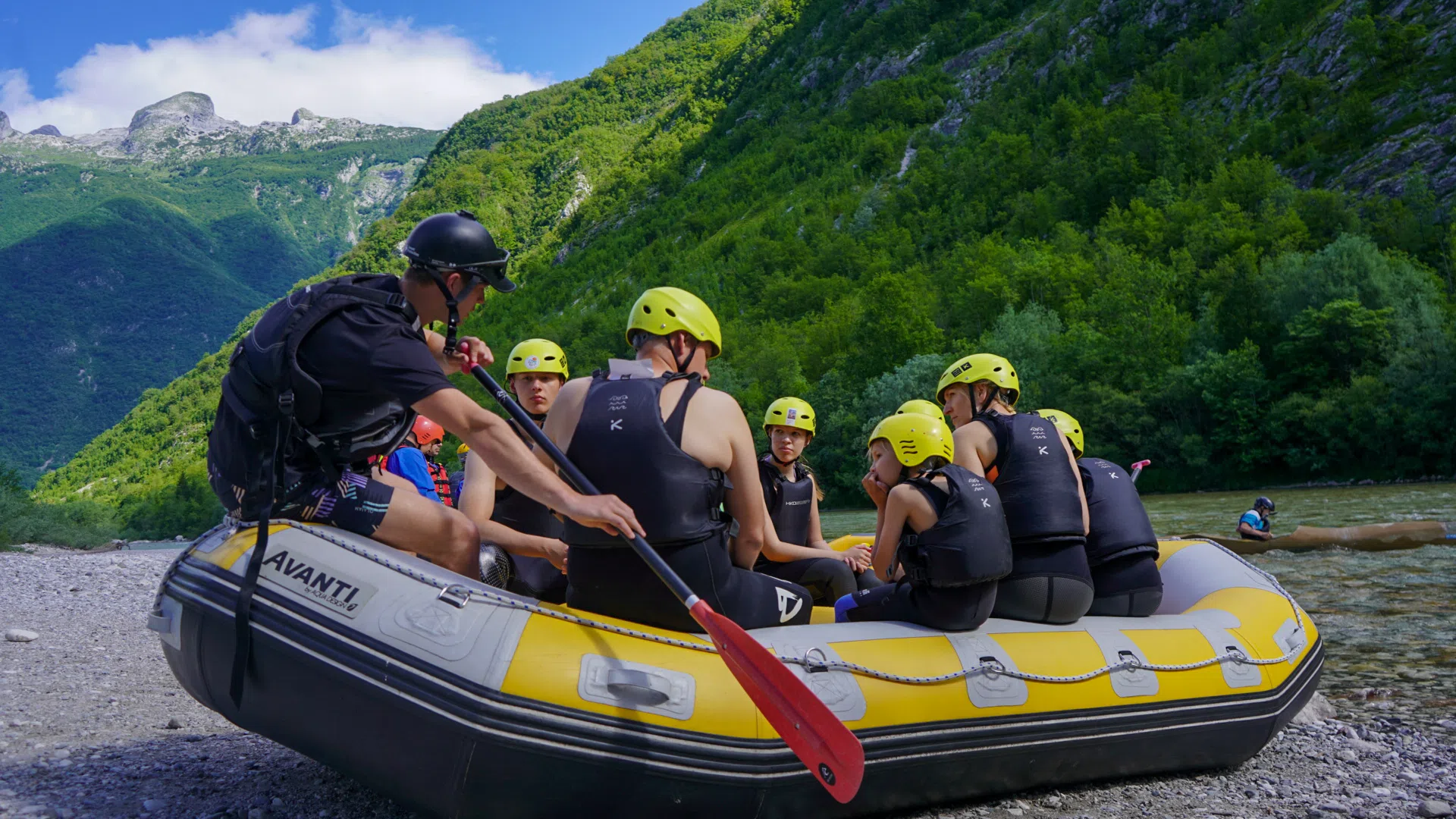
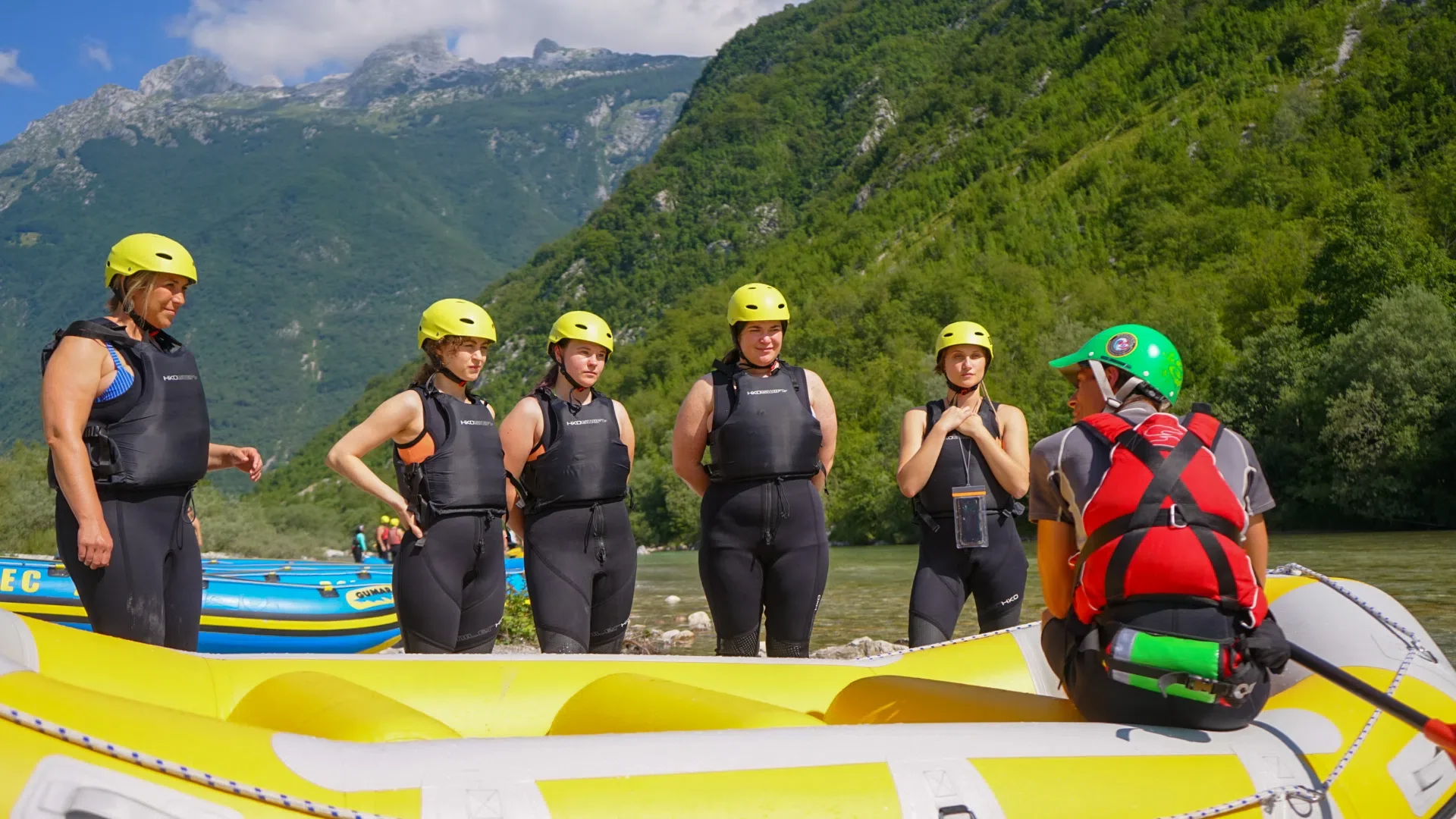
But equipment is only one part of rafting safety. Before entering the Soča River, we always go through a safety briefing with the entire group. We explain how to sit in the raft, how to hold and use the paddle, which commands you will hear from your guide and what to do if you end up in the water.
From the first rapid until we leave the river, everyone in the raft has a role to play. Your guide is there to read the river, control the raft and give instructions, while your job is to listen, paddle and work together with the rest of the crew.
Not Every Section of the Soča Is the Same
The Soča River runs through the Upper Soča Valley, connecting the areas around Bovec, Kobarid and Tolmin. But rafting conditions are not the same along the entire river. Different sections have different characteristics and levels of difficulty, from calm stretches of water to technical rapids.
The difficulty of a section is also not fixed. Water levels can change the character of the river considerably, which is why the same rapid may feel very different depending on the conditions that day.
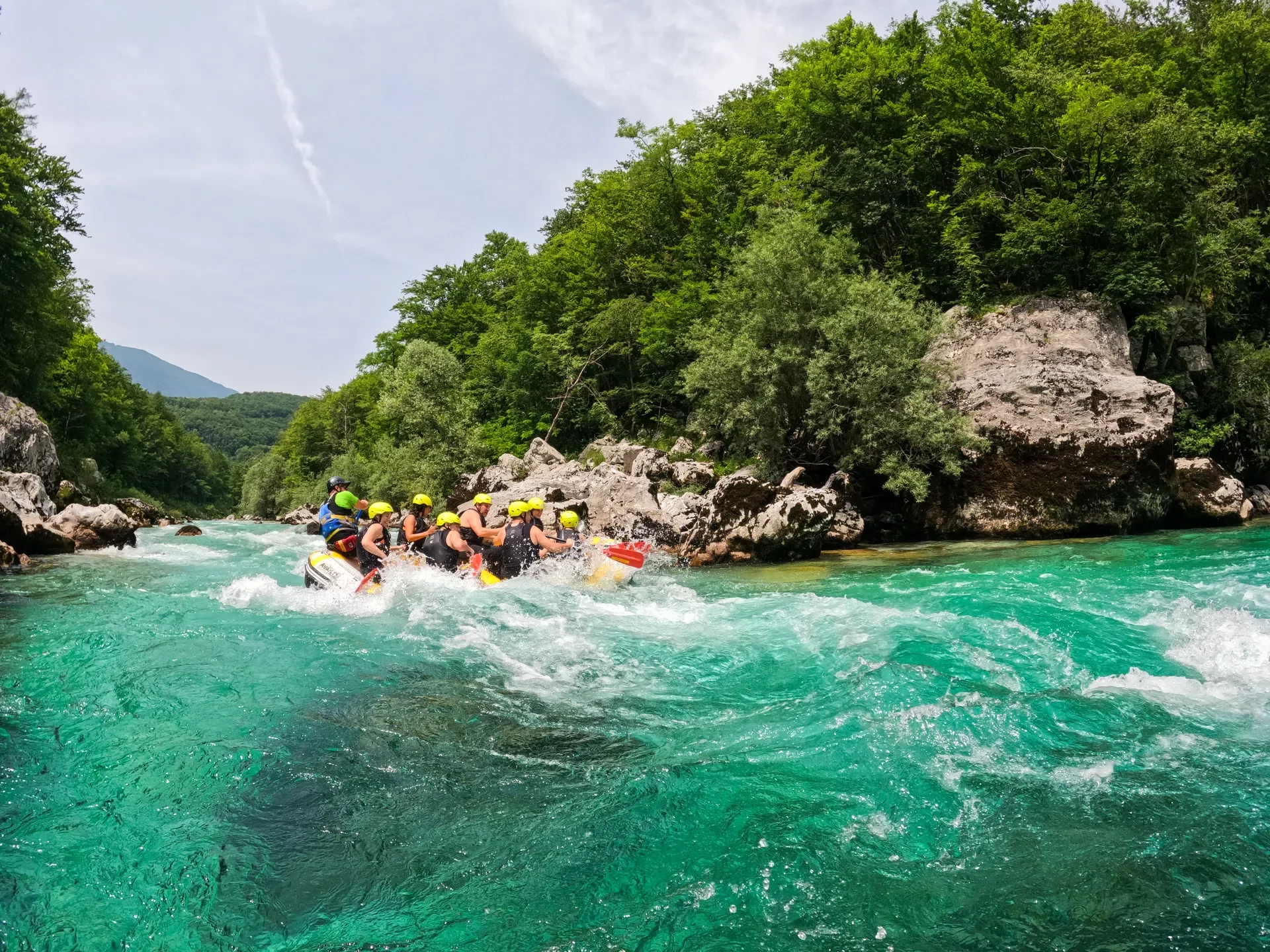
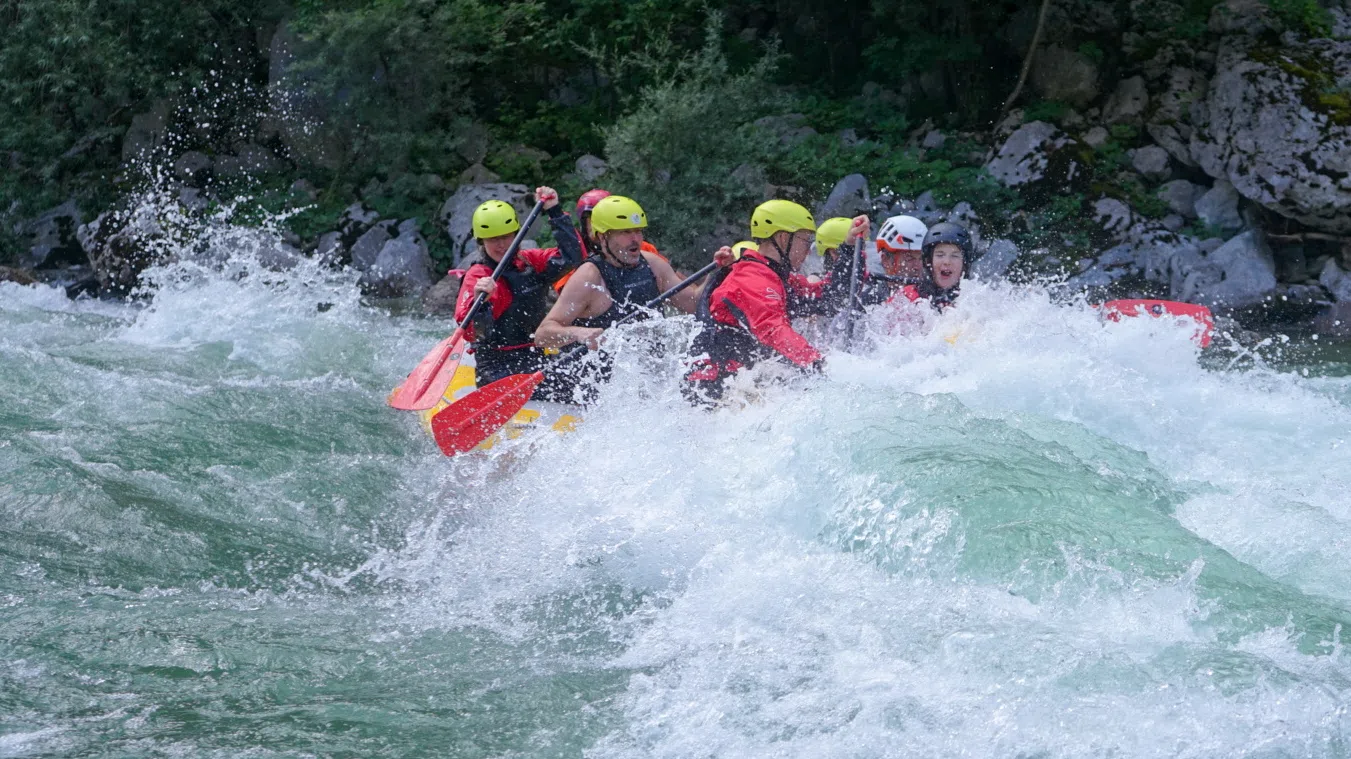
For our classic rafting trips, we normally use sections with rapids ranging approximately from Class II to Class IV. Before every trip, we consider the current water level, river conditions and the group itself before deciding which section is the most suitable.
CLASS I - EASY
Fast-moving water with small waves and few obvious obstructions. Risk is minimal and self-rescue is very easy.
CLASS II - NOVICE
Straightforward rapids with wide, clear channels. Occasional maneuvering may be needed, but rocks and medium waves are easily avoided.
CLASS III - INTERMEDIATE
Moderately difficult rapids with high, irregular waves, strong currents, and tight passages. Complex boat control and teamwork are required.
CLASS IV - ADVANCED
Long, very difficult rapids with powerful, chaotic waves, restrictive drops, and dangerous obstacles. Precise and fast maneuvering is necessary, and scouting from the shore is often required.
CLASS V - EXPERT
Extremely violent, obstructed, or long rapids with massive, unavoidable drops. The route is complex, highly punishing, and scouting is mandatory.
CLASS VI - EXTREME
The absolute limit of navigation. These runs involve extreme danger, unpredictable conditions, and a severe risk to life with little to no margin for error.
What Safety Equipment Do You Wear for Rafting
Before entering the Soča River, every guest is equipped from head to toe with professional whitewater equipment. The equipment is not there simply to keep you comfortable — each piece has a specific role if you end up in the water.
A helmet protects your head, while a PFD (Personal Flotation Device) provides buoyancy and helps keep you on the surface if you fall out of the raft. You will also wear a long-john wetsuit and neoprene shoes, which provide thermal protection in the cold water of the Soča and help protect your feet when entering or leaving the river.
When the weather is colder or rainy, we can add an extra neoprene jacket or anorak for additional protection from the cold, wind and rain.
The raft itself is also an important part of the equipment. We use professional whitewater rafts made in Slovenia and designed for rivers such as the Soča. Before every trip, the equipment and the conditions on the river are checked before we head to the starting point.
HELMET
Protects your head while rafting and if you end up in the water.
PFD - Personal Floatation Device
Provides buoyancy and helps keep you on the surface.
WETSUIT
Provides thermal protection in the cold water of the Soča.
NEOPRENE SHOES
Keep your feet warmer and provide protection when entering and leaving the river.
EXTRA LAYER
A neoprene jacket or anorak can be added in colder or rainy conditions.
The Safety Briefing: What We Teach You Before Entering the River
Before we enter the Soča River, every trip begins with a safety briefing. Even if you have never been rafting before, by the time we push the raft into the current, you will know where to sit, how to hold your paddle, how to follow the guide's commands and what to do if you end up in the water.
One of the first things we explain is how to sit securely in the raft. Guests sit on the outer tubes, on either the left or right side depending on where the guide places them. Your feet are positioned securely inside the raft under the foot straps or ropes. This gives you stability when the raft hits a wave, rock or sudden change in current and helps prevent you from falling out.
We then explain how to hold the paddle correctly. One hand always stays on the T-grip at the top of the paddle, with four fingers over the handle and the thumb underneath. This is important because an uncontrolled paddle can injure another person in the raft.
Three Commands You Will Use on the River
FORWARD
Everyone paddles forward together in the same rythm.
BACKWARD
Everyone paddles backwards together in the same rythm.
STOP
Place the paddle across your lap and wait for the next instruction. You still keep control of the T-grip.
For some sections, your guide may also use the command “Get in!”. This means moving from the outer tube into the middle of the raft and waiting for the next instruction.
Rafting Is Teamwork
Paddling together is just as important as paddling hard. The two people sitting at the front of the raft set the rhythm, while everyone behind them follows the same timing. This allows the whole crew to work as one team and makes the raft much easier for the guide to control.
Your guide reads the river, chooses the line and gives the commands, but the crew also has an active role. A guide cannot paddle an entire raft through the rapids alone. Listening, reacting to commands and working together are all part of rafting safely — and also a big part of what makes rafting fun.
What Happens If You Fall Out of the Raft?
Falling out of the raft is something many first-time guests worry about. It can happen while rafting, which is exactly why we explain what to do before entering the river.
The most important thing is not to panic. You are wearing a helmet, a PFD and the rest of your whitewater equipment, and your PFD provides buoyancy to help keep you on the surface while you follow the guide's instructions.
Swimming in moving whitewater is very different from swimming in a pool, lake or the sea. There are a few simple rules that make a big difference.
Never Try to Stand Up in a Rapid
One of the most important rules is never to try to stand up while you are being carried by strong current.
The riverbed can contain rocks, branches and other obstacles. If you try to put your feet down while the water is still moving strongly, a foot can become trapped while the current continues pushing your body downstream.
Instead, stay on the surface and move with the current until you can safely swim towards the riverbank or return to the raft.
Keep Your Feet Downstream
If you are floating through moving water, we teach you to keep your feet pointing downstream.
This allows you to see where you are going and use your feet to help protect yourself if you approach a rock or another obstacle. Your head remains upstream rather than being the first part of your body to meet what is ahead.
When there is a safe opportunity, swim towards the nearest suitable riverbank — left or right depending on the situation and your guide’s instructions.
Getting Back Into the Raft
In many situations, the raft will still be close to you.
Your guide or another member of the crew may extend a paddle towards you so you can be brought closer to the boat. Once you are alongside the raft, the guide can use the shoulder straps of your PFD to help pull you back inside.
The exact response always depends on where you are in the river, which is why the most important thing after falling in is to stay calm, listen to your guide and follow their instructions.
What If the Raft Flips?
A raft can also flip in whitewater, although this is not something that happens on every trip. The same basic principles apply: stay calm, rely on your PFD, do not try to stand in strong current and listen to your guide.
The guide's job is to manage the situation, bring the group back together and get everyone safely back to the raft or to the riverbank.
Do You Need to Know How to Swim for Rafting?
Yes. If you join one of our rafting trips on the Soča River, you need to know how to swim.
Even though you will be wearing a PFD throughout the entire trip, it does not replace basic swimming ability. Rafting takes place on moving water, and there is always a possibility that you may end up outside the raft.
If that happens, you need to be comfortable enough in the water to stay calm, follow the guide's instructions and, when necessary, actively swim towards the raft or a safe riverbank.
For this reason, we do not take non-swimmers on our rafting trips. If you are unsure whether your swimming ability is sufficient, let us know before booking and we can discuss it with you.
Is Rafting on the Soča River Safe for Children?
Yes, rafting on the Soča River can be a great activity for children and families, but choosing the right trip and river section is especially important when younger guests are involved.
Before taking a family rafting trip, we consider the age of the children, their swimming ability, how comfortable they are around water and whether they are nervous about the activity. We also take the current river conditions and water level into account.
Not every family needs the same rafting experience. Some children are confident around water and excited about the rapids, while others may need a calmer introduction to the river. Our job is to choose an experience where the whole family can feel comfortable and enjoy their time on the Soča.
Family Rafting or Classic Rafting?
For families with younger children, we offer a Family Rafting trip on an easier section of the Soča River. It provides the experience of paddling, being on the river and discovering the Soča from the water without immediately putting the family into the more demanding rapids of the classic section.
For older or more confident children, Classic Rafting may also be suitable. Rather than making that decision based only on age, we prefer to talk with the parents first and consider the child, the family and the river conditions on the day.
River Conditions Matter
The Soča River is constantly changing. Water levels, recent rainfall and weather conditions can all influence how a section of the river behaves, which is why we check the conditions before every rafting trip.
On normal days, we monitor the river regularly. During periods of rain or changing weather, we check it even more frequently because the water level can sometimes change considerably within just a few hours.
A higher or lower water level does not simply mean that rafting is “good” or “bad”. It can change the speed of the current, the size and character of the rapids and the difficulty of particular sections. This is one of the reasons why we do not automatically use exactly the same section in every situation.
What Happens When Conditions Change?
If the conditions on the river change, we adapt the trip. Depending on the water level, weather and the group, this can mean choosing a different starting point, finishing at a different location or using another section of the Soča that is more appropriate for the conditions that day.
The decision is made by the guides based on what we see on the river — not simply by following the same route every day.
Water levels also change throughout the rafting season. If you want to understand how spring, summer, rainfall and different water levels affect the experience, we explain it in more detail in our complete rafting season guide. Best Time for Rafting on the Soča River →
Rafting Is Teamwork: Your Guide Can't Do It Alone
A professional rafting guide plays the central role in navigating the Soča River, but rafting is still a team activity. The guide reads the river, chooses the line through the rapids, controls the raft and gives the commands — while everyone else in the boat helps make those decisions work.
When your guide calls a command, the crew needs to react together. Sometimes that means paddling forward or backward, sometimes changing position in the raft, and sometimes simply stopping and letting the guide manoeuvre the boat.
This is why rafting is different from simply being a passenger on a river. Everyone in the raft has a role.
What Does the Guide Do?
Your guide is constantly looking ahead and reading the river. They watch the current, waves, rocks and other obstacles, choose the best line and position the raft before entering each rapid.
At the same time, the guide is paying attention to the crew — how well everyone is working together, whether the commands are understood and how comfortable the group is as the trip progresses.
What Is Your Job?
Your part is much simpler:
Listen to your guide. Paddle when asked. Follow the commands. Work together with the rest of the crew.
You do not need to know how to read whitewater or decide where the raft should go. That is the guide's responsibility. But when the guide needs the raft to move, the paddling power comes from the whole team.
First Time Rafting? That's Completely Normal
For many of our guests, rafting on the Soča River is their first rafting experience ever. You do not need previous rafting experience to join us — teaching you what you need to know is part of our job.
It is also completely normal to feel a little nervous before the trip. Some guests arrive at our office excited, others are not quite sure what they have signed up for yet. Before we leave for the river, we take the time to explain the trip, prepare your equipment and answer any questions you may have.
Once we reach the river, the experience builds up gradually.
The First Part: Getting Comfortable
The beginning of our Classic Rafting section is easier and gives you time to get familiar with the raft and the river.
This is where you can practise the commands from the safety briefing, find the paddling rhythm with the rest of the crew and understand how the raft reacts when everyone works together.
By the time we reach the more demanding part of the river, the commands that sounded completely new at the start already begin to feel natural.
The Second Part: More Rapids, More Action
The second part becomes more dynamic, with bigger rapids and more action.
At this point, however, you are no longer stepping into the unknown. You have already spent time on the river, practised the commands and learned how to work together as a crew. This natural progression is one of the reasons the Classic Rafting trip works so well for first-time rafters.
When Rafting May Not Be Suitable for You
Rafting is suitable for many people, including complete beginners, but there are situations where joining a whitewater activity may not be safe.
Before every trip, we ask our guests to tell us about any injuries, medical conditions or other circumstances that could affect their ability to participate safely. Please be open with your guide — even if something seems minor. It is much better for us to discuss it before leaving for the river than to discover a problem once the trip has already started.
Depending on the condition or injury, we will assess whether participating in the activity is appropriate. In some situations, we may decide that rafting is not suitable because we cannot provide an acceptable level of safety.
Who Cannot Join Our Rafting Trips?
There are several situations where we do not take guests rafting:
NON-SWIMMERS
All participants must know how to swim. A PFD provides buoyancy, but it does not replace basic swimming ability.
PREGNANCY
We do not take pregnant guests rafting. Whitewater involves sudden movements, impacts and situations that cannot always be predicted.
ALCOHOL OR DRUGS
Anyone under the influence of alcohol or drugs cannot participate. You need to be able to understand instructions, react quickly and work with the rest of the crew.
CERTAIN HEART CONDITIONS
Rafting can involve physical effort, cold water and adrenaline. Guests with heart problems need to tell us before the activity, and there are circumstances where we will not be able to take them rafting.
SERIOUS INJURIES OR PHYSICAL LIMITATIONS
An injury or physical condition that significantly limits your ability to sit securely, paddle, move inside the raft or react to instructions may make rafting unsuitable.
Not Sure? Ask Us Before You Book
Not every old injury or medical condition automatically means that you cannot go rafting. What matters is whether you can participate safely in the activity and respond appropriately if something unexpected happens.
If you are unsure, contact us before booking and tell us about your situation. We can discuss it with you and determine whether rafting is an appropriate activity for you.
Is Rafting on the Soča River Safe? Our Answer
The Soča is a wild Alpine river, and like any outdoor activity, rafting can never be described as completely risk-free. The river deserves respect, and conditions can change from one day to another.
What we can do is reduce those risks through preparation, professional equipment, trained guides, the right choice of river section and a clear safety briefing before entering the water. Just as importantly, everyone in the raft needs to listen, follow the commands and work together as a team.
For most of our guests, rafting on the Soča is their first whitewater experience. You do not need previous rafting experience, but you do need to know how to swim, be able to participate physically and be prepared to follow your guide's instructions.
At Soča Pulse, we do not believe that safety means pretending there are no risks. It means understanding the river, respecting its power and making good decisions before and during every trip.
And once all of that is taken care of, there is plenty of time for the reason we go rafting in the first place — to paddle, enjoy the rapids and have fun on one of Europe's most beautiful rivers.